
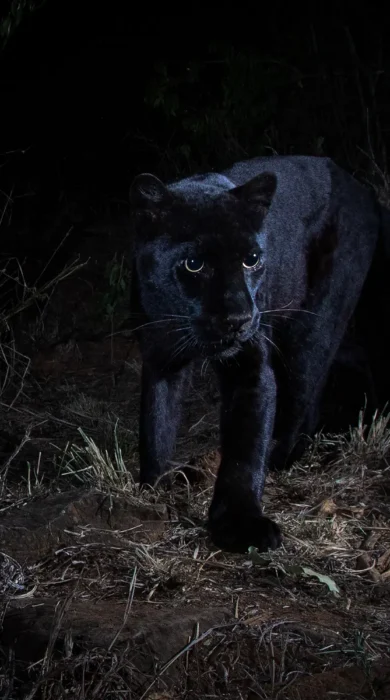
The Elusive Kenya Black Leopard
Senior Safari Specialist Jo recently returned from an action-packed research trip to Kenya. During her explorations of Kenya’s scenic Laikipia region, she had the chance to glimpse the elusive black leopard.
In October 2025, Jo visited the Laikipia region of Kenya. This must-see region is home to diverse landscapes and a variety of wildlife, including several rare species – the elusive black leopard is one of the most exciting to see in the wild. Even for our seasoned experts, a sighting of a melanistic leopard is a safari highlight.
The Moment of Discovery
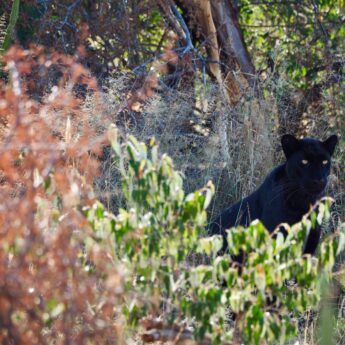
Arriving at Laikipia Wilderness Camp, there was a sense of excitement about the chance to see a black leopard. While spotting Giza, the female laikipia black leopard who was born and raised 1 kilometre from the camp, was not the priority, Jo and her fellow safari-goers shared with each other that they had their fingers crossed for a sighting.
The following day, Jo rumbled across Laikipia’s plains on an afternoon game drive, led by an exceptionally knowledgeable Samburu guide, Steven. With hindsight, she suspects Steven had Giza in mind all along, but at no point did it feel like a mission or a chase. Instead, the landscape revealed itself at its own pace – an elephant family crossing the river, a shy and rarely seen ‘regular’ leopard perched on a kopje, and a backdrop of remarkable birdlife.

Then, with seemingly perfect timing, the group came across Giza. She was already on the move, low and deliberate, stalking unseen prey hidden deep in a thicket. For nearly 45 minutes, Jo watched in silence as Giza edged forward, inch by inch. Even with binoculars, there was no sign of what she was hunting. Only when she finally pounced did it become clear – a scrub hare. The hunt was unsuccessful, something Steven explained is far more likely in daylight, when Giza’s dark coat offers less camouflage.
There were only two other vehicles present, and Jo said the sighting felt calm and unhurried. The guides gave Giza space, and the moment was allowed to unfold naturally. Luck definitely played a part, but Jo believes it was Steven’s deep understanding of Giza’s behaviour that placed them in exactly the right position for an extraordinary first encounter.

What is a Black Leopard?
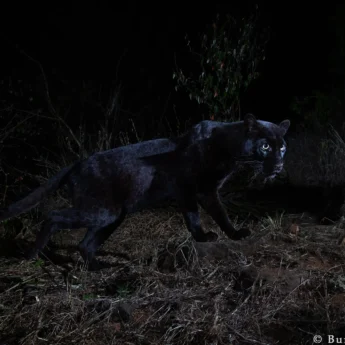
A black leopard is not a separate species, but a leopard with a rare genetic trait called melanism. This causes the big cat to develop an excess of dark pigmentation, giving the coat a striking black appearance, though the familiar rosette pattern is still visible in certain light. Melanistic leopards are most commonly found in dense woodlands and tropical forests, with Laikipia one of the few places in Africa where they are seen.
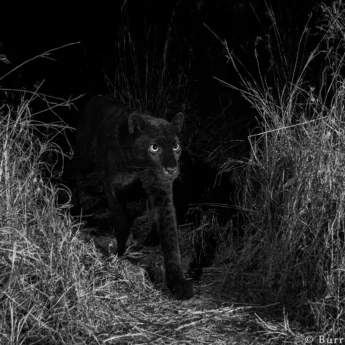
In Laikipia in 2019, photographer Will Burrard-Lucas was one of the first photographers to get a shot of the extremely rare black leopard. He captured something that had been a myth – stories about the creature had been circulating for years through the wildlife community, but no sighting had ever been confirmed. Since Giza was first photographed, local researchers have reported sightings of ten individual melanistic leopards in the greater Laikipia area.
Where can I see a Black Leopard in Africa?
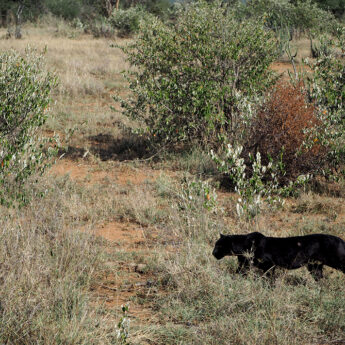
Laikipia is a stand-out area for seeing black leopards in Africa. This is largely thanks to the landscape, as it’s believed that the black leopard could be better suited to adapting and hunting in the Laikipia biome. The bush is generally thick throughout the area, and the black leopard, being melanistic, blends in better with the rocky kopjes, caves, hills, and with the shadows of the trees and thick shrubs, making them more camouflaged. While this area of Laikipia has particularly high numbers of black leopards, none is habituated like Giza, so the sightings are fleeting.
Lodges here tend to offer black leopard-focused game drives. At Laikipia Wilderness Camp, Black Leopard private and shared vehicles are available to book for game drives. These black leopard vehicles give passengers priority slots at a sighting. While seeing Giza is not guaranteed, as she is a wild animal and can be unpredictable, if glimpsing her in the wild is your focus, there are several ways to maximise your chances, such as booking a longer stay and embarking on more game drives.

There have been sightings of black leopard in another part of Kenya – in a mountainous forest called the Aberdares, which is south of Laikipia and west of Mount Kenya. The Aberdares forest is very thick, so finding and photographing the black leopard there is a monumental task – you would have better chances in Laikipia.
Further abroad, India and Sri Lanka also have black leopards, but sightings are more challenging due to the dense foliage of the forests where they live.
How do I plan a trip to see a Black Leopard?
Seeing a black leopard requires patience, local knowledge, and realistic expectations. We recommend visiting Laikipia, where the landscapes, long-term conservation and low vehicle numbers make sightings more likely. Most importantly, plan your trip with a safari specialist who has deep knowledge of the region and can advise on the best safari for you.
Speak to an Expert
Let one of our Yellow Zebra specialists design
your tailor‑made African adventure