



Spotted hyenas are one of Tanzania’s most widespread and adaptable predators, living in grassland, woodlands, forests, desert, mountains, and even urban environments. This is helped by their diet as opportunistic carnivores and scavengers. From antelope kills, to tortoises, to even household waste… they are not fussy eaters! And while they often steal kills, they also frequently hunt as a pack, with a strongly matriarchal social structure. Female hyenas are typically bigger and stronger than males and can even have higher levels of testosterone. Clans can range from a few individuals to over 100 scattered over a broad area. Hyenas are often reviled in popular culture and regarded as vermin, meaning numbers have decreased due to the expansion of farming and the resultant persecution. However, hyenas play a key ecological role in the disposal of carcases and are a keystone species in conservation efforts. They are also full of mischievous character! You won’t forget your first hyena sighting.
Beyond the Big Five: The Diverse Wildlife of Tanzania

Rich in national parks and game reserves, and including the brilliant beach destination of Zanzibar, Tanzania has so much to offer the nature lover, and when it comes to wildlife, the country is a real treasure trove!
Tanzania has so many diverse and interesting locations when it comes to wildlife. It’s home to unique national parks and game reserves, each offering something different. There’s also the stunning marine life to be found in the reefs off the beautiful shores of Zanzibar and its satellite islands.
Most people think of the Serengeti when they consider Tanzania, with its stunning year-round game and the famous migration river crossings. However, there’s a host of other safari possibilities within the country, so let’s talk about the incredible variation of wildlife and where to find them…

The Big Five in Tanzania
Let’s start with the famous Big Five – lion, rhino, leopard, buffalo, elephant. It is possible to see all of them in the Serengeti and Ngorongoro Crater, both in northern Tanzania. Nyerere in the south has all five too, in theory, but it’s very unusual to spot rhino here (though there is a legend that just one lives in this region!). There are no rhino in the national parks of Tarangire and Lake Manyara (north), Ruaha (south), and Katavi (west), but the other four massive mammals are in residence here, in varying concentrations.
The Big Five
Lions
Elephants
Leopards
Rhinoceroses
Buffalo
-
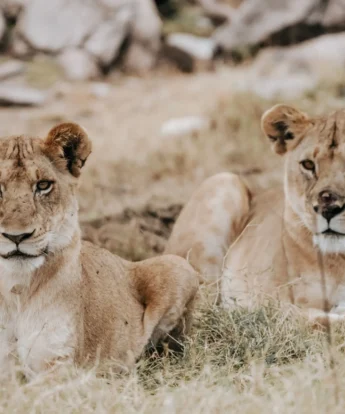
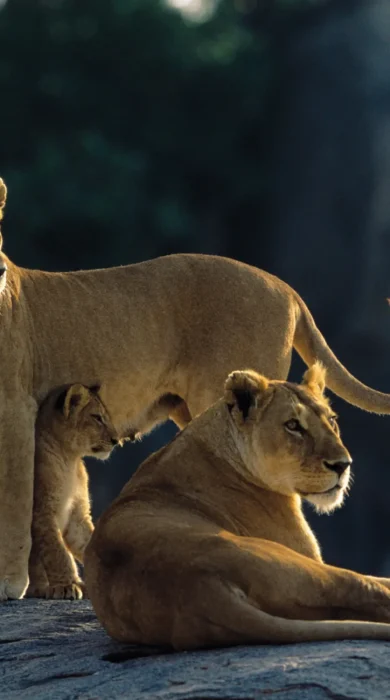
Lions are the most sociable of the big cats, and Tanzania has the highest population of wild lions on Earth! They can be found in most parks, notably the Serengeti, Nyerere National Park (formerly Selous), Ruaha, Tarangire, and the Ngorongoro Crater. In Ruaha the lions live a hard life, and sightings when made tend to be of large prides. In the Serengeti, we see interesting behaviors, with some lions becoming nomadic and following the herds of wildebeest, while others stay in their territories. A good place to see lions is around rocky outcrops and denser, shaded areas during the day, when they are resting.

These magnificent, intelligent animals are a mainstay of most parks in Tanzania, from the plains of the Serengeti to the forests of Lake Manyara National Park. There has been a resurgence of elephant numbers after the clamping down of poaching for ivory. The Serengeti almost lost all its elephants, but now populations are healthy and growing again. Elephants need to drink every day, so are easily found around water sources. There is also the amazing elephant migration, when Tarangire plays host to thousands in the dry season (July to October).
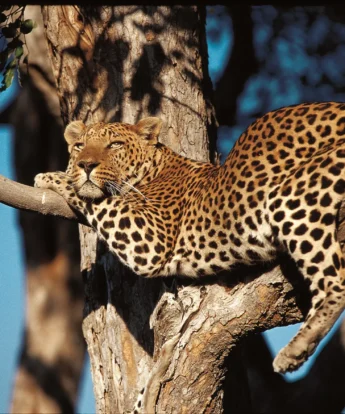
These elusive cats can be one of the species most difficult to spot due to their secretive nature. They tend to spend their days in areas where they can rest without worrying about other predators, i.e. large trees, rocky outcrops, and denser riverine areas. They particularly love trees – always check large horizontal branches for a snoozing leopard! Often they hoist their food up into large trees to avoid losing it to hyenas and lions. They are best seen in the Serengeti, Tarangire, Ruaha (small numbers, but they can be found in riverine bushland here and guides often know exactly where), and Katavi.
This impressive megafauna holds special conservation status across Africa, and while there are pockets of black rhino in the Serengeti (with specific areas designated by the park rangers), and some in Nyerere, they are still rare to see. By far the best place to see black rhino is the Ngorongoro Crater. There are resident rhino who live in this amazing caldera, although numbers are unknown and kept a secret. And because the crater has no off-roading you have to be lucky to see one close-up!
These unpredictable animals are grazers and need to drink water every day. They can be found in enormous herds numbering thousands, in smaller groups, or even solitary. These small groups leave the herds to avoid competing for food when they are no longer able to reproduce, and become known as ‘Dagga Boys’. Adult buffalos are formidable and are preyed on only by lions, often working as a team. Buffalos tend to head to water in the mornings and afternoons, then rest during the heat of day and chew their cud to help with digestion. They are generally found throughout Tanzania’s parks.
Big Cats
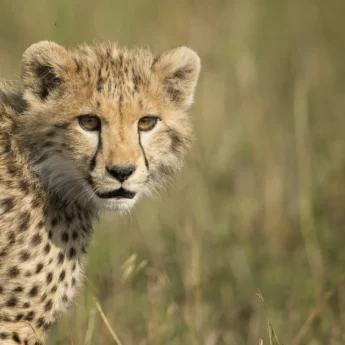
As well as lion and leopard, other members of the cat family can be spotted during your safari activities (and even from the air during hot air balloon rides!) Famous for their speed and agility to chase down prey, cheetahs can also stalk and hunt in scattered woodland areas if necessary. Stealth and surprise are key to getting the edge on their prey. But they certainly prefer locations where they can see wide stretches around them, to avoid other predators. And they will often make use of fallen trees or termite mounds to see as far as possible. They are mainly active during the day, to avoid other predators. Cheetah live in all the northern parks except Lake Manyara. The Serengeti is superb for cheetah thanks to the vast open plains and abundance of smaller gazelle species, such as Thomson’s gazelle. They are also found in Ruaha and Katavi, which have the sprawling plains needed for them to hunt at speed.
The Serengeti and Ngorongoro areas also contain a number of smaller species, such as serval, caracal, and (in Ngorongoro) the elusive golden cat, a truly beautiful creature!
Wild Dogs & Other Carnivores
There are plenty of other predators who also provide amazing game viewing. In the north of Tanzania there are golden jackals, as well as black-backed and side-striped jackals, and other types of animals commonly listed as ‘dogs’ – bat-eared fox, for example, and of course the elusive African wild dog. Other meat-eaters you might spot in Tanzania include spotted hyena (most of the north and Nyerere), striped hyena (Serengeti), and carnivorans (placental mammals) such as civets. On walking safaris, keep your eyes peeled for insectivores – the African hedgehog and elephant shrew, to name just a couple of small, bug-eating beasts!
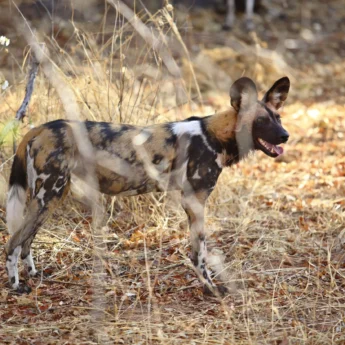
Wild dogs have fascinating hunting strategies and social structures, and are one of Africa’s rarest predators. Hunting as a pack (sometimes more than 20) and relying on stamina to wear down their prey rather than ambush, wild dogs are vastly more efficient hunters than the large cats – 80% of their hunts end successfully! The pack is dominated by a monogamous breeding pair, with non-breeding members contributing to raising young. Highly intelligent, they also use loud greetings and social rituals before hunts, to forge and maintain the cooperative social structure within the pack. Their wide-ranging territories make them difficult to spot, but if you do get a glimpse they are a prized sighting indeed! Nyerere and Ruaha national parks are where you can find them in Tanzania.
Hyenas & Jackals
The three jackal species (golden, side-striped, and black-backed) have individual ranges and preferred habitats. The golden jackal is the desert-adapted form and is particularly found on the open plains of the southern Serengeti. The black-backed jackal is closely associated with dry Acacia savannahs such as in the northern Serengeti. The side-striped is the most versatile, but tends to prefer wetter and more forested areas such as Lake Manyara and Tarangire. Although canines, jackals have a considerably smaller and less complex social structure, and are most often found living singly or in pairs. Jackals are typically nocturnal, so camps that do night drives will maximise your chances of seeing these elusive predators. They are also opportunistic scavengers, but aren’t large enough to compete on kills. Keep an eye out for them waiting on the perimeter of kills, or on older carcasses that no longer have enough meat to hold the interest of a larger species.
Plains Game
The herbivore numbers in Tanzania are also very impressive, especially as the Serengeti is home to the Great Migration. For large parts of the year it hosts vast herds of wildebeest, plains zebra, and Grant’s and Thomson’s gazelles. These species are found in all the main safari parks in the country. There are plenty of giraffe too, in addition to bushpig, warthog, and hippopotamus. Fans of spiral-horned bovines (cow-like antelopes with twirly horns) will be thrilled to spot eland, bushbuck, and both greater and lesser kudu. The Serengeti is our top tip for this sort of animal, with Tarangire a close second.
Although zebra and wildebeest are widespread throughout Tanzania’s parks, undeniably the best place for seeing large herds is Serengeti National Park, where 1.5 million wildebeest and 200,000 zebra chase the annual rains and the explosion of grassland that follows. You can see these huge herds at any time of year in Tanzania if you pick your camp carefully! For spectacular sightings you should head to the ‘western corridor’, but mainly up into Kogatende and the Lamai Wedge of the Serengeti through July to October, when the wildebeest famously hurl themselves across the Grumeti and Mara rivers in search of better grazing, with crocodiles and lions picking off stragglers in an extraordinary display. Another exciting time of year is February, when the herds gather in the southern plains of the Serengeti in preparation for calving.
Hippos are semi-aquatic animals, synonymous with Africa and highly dependent on water, so wherever you find water in Tanzania’s national parks the chance of seeing them is strong. Once the sun goes down the hippos come onto land to graze. Although present in Lake Manyara and the swamps of Tarangire, they turn up in relatively low numbers here. The best locations to find large pods are the lakes on the floor of the Ngorongoro Crater (albeit at a distance) or the Mara river in the northern Serengeti. The best place to see them up close and in large numbers is while on a boating safari on the Rufiji River in Nyerere National Park.
The Smaller Wildlife of Tanzania
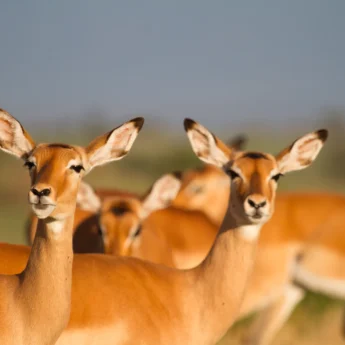
There’s an abundance of antelopes in Tanzania. Gray duiker, Kirk’s dik-dik, klipspringer, steenbok, oryx, roan, sable, the elegant long-necked gerenuk… the list goes on and on! There are Coke’s and Lichtenstein’s hartebeests, impala, topi, reedbucks, and waterbucks too. And if you’re fond of rodents, you can look out for Cape hare, spring hare, and the jaunty crested porcupine. There’s also an exciting variety of mongoose – slender, white-tailed, banded, dwarf – plus honey badger, bush hyrax, and the extremely rare ground pangolin!
Primates Found in Tanzania
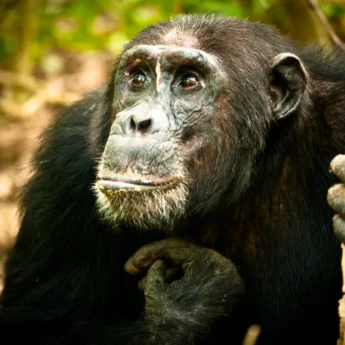
From bushbabies to patas and vervet monkeys, from black-and-white colobus to olive baboon, these guys pop up in a few of the national parks. However, for a really great ape experience, head west to the Mahale Mountains and meet the ancestors – chimpanzees! This is a very remote part of the world (and fairly expensive to get to), but a trip to Mahale in the west of Tanzania ranks as one of our top wildlife destinations – it really is superb. Nomad Tanzania owns the best lodge here as well as in Katavi, and operates the flights, so if you’re thinking of doing this amazing trip it makes sense to use their deals for a full package into the west, into the wild!
Birdwatching in Tanzania
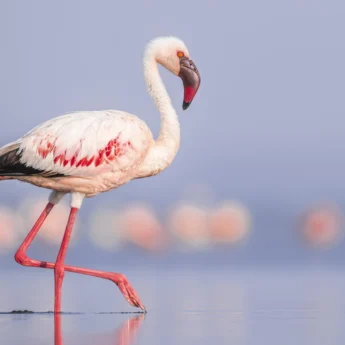
Another fantastic destination, although for different reasons, is Lake Natron. We stress this is not a Big Five game area, and populations of mammals amount to just a handful of herbivores. However, if you love birds, then this is the place for you and it’s well worth the trip. That’s because, from November to April every year, the salt-and-soda lake is home to over 2.5 million lesser flamingo – the world’s largest breeding colony!
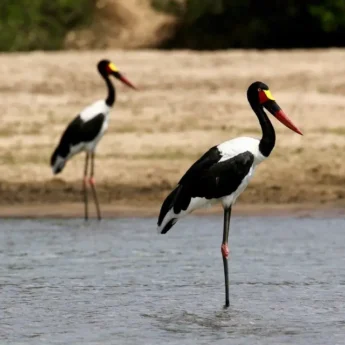
Birding elsewhere in Tanzania is excellent too. You can see both greater and lesser flamingos in the northern and southern safari areas, as well as a lot of other waterfowl. Avocets, bitterns, cormorants and shags, ducks and geese, ibises, herons, jacanas, kingfishers, plovers, pelicans, sandpipers, snipes, stilts and storks… parts of this country really are a birder’s paradise! Many of the national parks contain abundant raptors too, as well as babblers, bulbuls, bee-eaters, canaries, cuckoos, crows, darters, doves, drongos, flycatchers, finches, francolins – and that’s just the start of the alphabet! With individual park highlights including the crowned crane, secretary bird, and wonderfully named bare-faced go-away bird, we highly recommend that you remember to bring your binoculars!
Flamingos & Raptors
Flamingos can be seen throughout the year in Tanzania, congregating in shallow saline lakes in the north, where they feed on blooms of (usually toxic) algae that give the birds their distinctive colourful plumage. Flamingos will migrate between different lakes to find preferential feeding and breeding locations. Sometimes changing water levels in lakes will create unfavourable conditions for their algal food source, forcing an exodus. Depending on these water and food levels, the flamingos will migrate between lakes such as Natron and Ndutu in the Ngorongoro Conservation area, Lake Magadi on the floor of the Ngorongoro Crater, and the Momela lakes in Arusha National Park. Other migratory patterns can be more predictable, such as movements to preferred breeding sites. For example, in Lake Natron, huge flocks typically gather from September to December.There are some real big hitter raptors in Tanzania, an incredible diversity of birds of prey, including eagles, buzzards, falcons, hawks, and vultures. The African fish eagle prefers rivers and large lakes, and can be seen in Lake Manyara and on the Rufiji River in Nyerere National Park. The martial eagle (one of the largest in Africa) loves open woodland savannah and can be found in the Serengeti and Tarangire. The Bateleur eagle with its distinctive red face can be seen in the Serengeti and Ruaha. The African harrier-hawk likes forests and wooded areas, and can be seen in Nyerere. The biggest vulture in Africa, the lappet-faced vulture, is often spotted in the Serengeti and Tarangire. These are but a few of many species of hunters!
Wildlife Along Tanzania’s Coast
The Zanzibar Archipelago has the best beach locations in Tanzania for viewing coastal wildlife. There are 117 species of bird, among them falcons, guineafowl, flamingos, grebes, spoonbills, storks, gray-headed lovebird, rose-ringed parakeet, and the laughing dove. The south-eastern area contains Jozani Forest, featuring dwarf antelope, blue duiker, bush-tailed mongoose, African and Indian civet, red colobus, and green and hawksbill turtles. There is also a turtle sanctuary located on Zanzibar’s north coast – however, we don’t recommend viewing these creatures in sanctuaries or aquariums. Off the coast, coral reefs are teeming with colourful fish, so if you’d like to continue your safari while at the beach, Zanzibar’s archipelago is a fabulous pairing.
Speak to an Expert
Let one of our Yellow Zebra specialists design
your tailor‑made African adventure