
That said, warthogs like nothing better than finding a muddy waterhole and wallowing in the cooling waters. After their bath, the water evaporates from the skin, carries the heat away, and leaves a layer of protective mud behind – the perfect natural skincare.

Some Like It Hot: How Animals Deal With the October Heat

Imagine thunder that rattles your bedroom windows, torrential rain that sweeps past in 10 minutes, and a desert-like landscape that suddenly erupts into a green oasis filled with a kaleidoscope of incredible birdlife – this is the siren call of the wet season in southern Africa. But now imagine a few days before the start of the green season, and you have a wildlife and a land that is utterly desperate for rain.
October for southern Africa’s wildlife can be a harsh month (though it’s the perfect time to visit for an action-packed and wildlife-filled safari). With no rain having fallen since around March, countries like Zimbabwe, Zambia, Botswana, and South Africa are gaspingly dry – and with temperatures on the rise fast, it is no wonder that October is often referred to as ‘Suicide Month’.
With possibly one more month to go until the welcoming relief of the African rains, the question is, how do animals deal with the dry heat? Below, we highlight some of the sophisticated ways in which they cope:
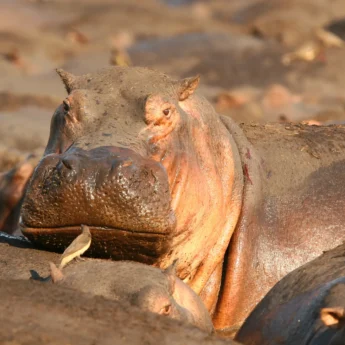
Hippos ‘sweat blood’
Only mammals have the ability to sweat – and very few at that, because most mammals do not have sweat glands. In October, when there is little water and the temperatures are increasing, hippos have a unique solution to keeping cool. They do not sweat in the traditional sense but rather secrete a reddish-orange liquid that essentially acts as a form of sunscreen, protecting the hippo from sun damage during the day’s feeding. The Ancient Greeks used to think that hippos would sweat blood because of the thick red substance; however, a recent study discovered that the sweat is made up of two pigments – one red, which acts as an antibiotic, and one orange, which works as the sun blocker.
Marabou storks embrace urohydrosis
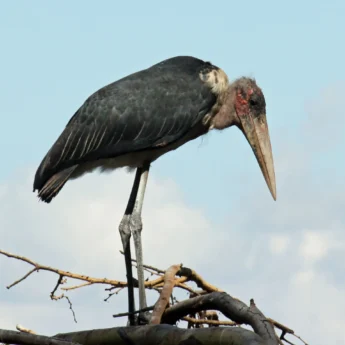
Often called the ugliest bird in the world, there is no denying that the marabou stork is peculiar looking. It has a featherless neck, a pink speckled face, a large and fleshy pink wattle, and very long gray legs, which actually appear white most of the time. This whiteness on their legs is in fact a build-up of excrement. Marabou storks will defecate on their legs to cool down, an interesting cooling system called urohydrosis. As bird poo is mostly liquid, it works in the same way as sweat, through evaporative cooling. As the faeces dries on the birds’ legs, heat is lost, bringing the stork’s body temperature down. For marabou storks, the white also aids in further cooling by reflecting the harsh sun. This might not seem a hygienic way to deal with the heat, but it is certainly effective and necessary.

Elephants target their contracting hot spots
Larger animals retain heat more than littler species because they have a smaller surface area for heat to escape from in relation to their bulk. Bring in the African elephant, and you have the heaviest land mammal in the world battling the heat without any sweat glands except between its toes.
If you’ve ever traveled to Africa, you’ll know that if you wait long enough by a waterhole you’ll eventually see a herd of elephants approach and have a good wallow. After a cooling and cleansing bath, the elephants will then have a lengthy dust session or roll around in the mud, which helps protect their skin from the harsh sun rays. Using thermal cameras, biologists have recently discovered that elephants are also covered in ‘hot spots’. When elephants overheat, their blood supply is directed to these small patches of skin and heat is rapidly lost, resulting in a fine-tuned mechanism in heat regulation. These patches are scattered all over an elephant’s body as well as in large areas on their ears, and they can even expand and contract depending on the air temperature
Ostriches breathe deep and bare all
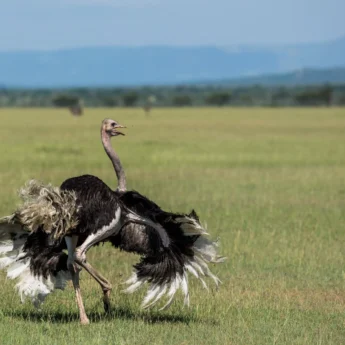
Instead of escaping the heat under shady trees or in waterholes like most animals, ostriches rely on their desert-adapted bodies to deal with the blistering temperatures. They use a unique series of cooling techniques called ‘behavioural thermoregulation’. These include baring their upper legs, flanks, and thorax to release heat, using a ‘selective brain cooling’ mechanism to manage the temperature of the blood going to the brain, and manipulating the airflow through their lungs to transfer heat through evaporation. Because of these adaptations, ostriches are able to live in the dry African savannas and deserts, withstanding air temperatures of up to 56 degrees Celsius without undue stress.
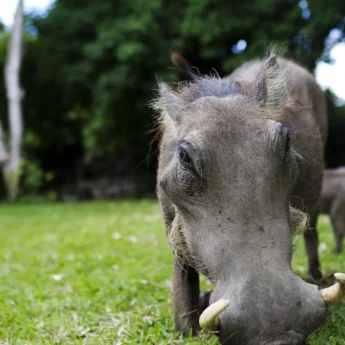
Warthogs adapt and wallow
Speak to an Expert
Let one of our Yellow Zebra specialists design
your tailor‑made African adventure