

Murchison Falls National Park Safaris
Murchison Falls is home to Nile crocodile and hippopotamus. It is situated in the north-west and is a great add-on to an Uganda safari.
When to go to Murchison Falls National Park
Best Time to Go
Great safari addition or standalone destination
Wealth of wildlife

Spectacular falls – the Victoria Nile drops for 45m
River cruises, game drives and chimpanzee treks

Uganda’s Famous Falls
Located at some distance from the cluster of national parks in Uganda’s far west, Murchison Falls is usually offered as an add-on to a trip involving any of Bwindi Impenetrable, Queen Elizabeth, and Kibale Forest. It is usually accessed from Kampala, the country’s capital city, with travellers making the journey of almost 300 kilometres by road, or by air from Kajjansi Airfield. Alternatively, it is certainly a sound standalone destination, featuring many areas of interest and plenty of wildlife.
The sheer sight of the cascading water has enticed visits from famous persons throughout the twentieth century. In 1907, Winston Churchill enjoyed boat cruises, hiking, and biking in the area, and the Queen Mother came to admire the falls in 1959.
Murchison Falls National Park Trips
Activities & Wildlife
In addition to the falls, other activities in and around the park including birdwatching, community walks, and excursions to Ziwa Rhino Sanctuary. Murchison Falls is well worth considering for your Uganda safari.
Visit the Falls
Wildlife
-
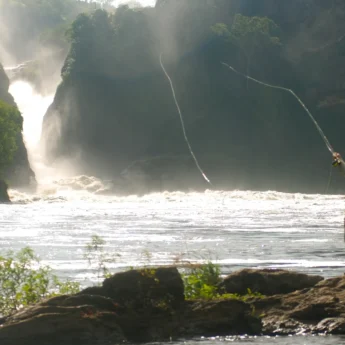
Naturally the falls are the main attraction of this national park. The most popular activity is a boat trip along the quiet stretch of the river to observe the falls and spot wildlife along the way. This area is home to Nile crocodile, hippopotamus, and an assortment of waterbirds such as shoe-billed stork, Goliath heron, great blue turaco, white-thighed hornbill, and the endearing dwarf kingfisher. Big game, including elephant, buffalo, and giraffe, is often spotted on the riverbanks. The falls are also worth viewing from above.

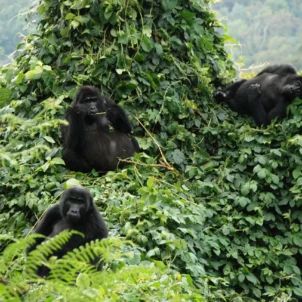
Geographically, it is a region of two parts – savanna, borassus palms, acacias, and riverine woodland in the north, and patches of forest in the south. The savanna supports a wealth of plains species, predated by lion and leopard. Visitors can go on game drives to check out all the animal action. Of the classic Big Five, only rhino are not found here. The forests of neighbouring Bugungu are home to chimpanzee, which may be seen on chimp treks.

History
Murchison Falls National Park is part of the Murchison Falls Conservation Area, with the wildlife reserves of Karuma and Bugungu. The park covers approximately 3,893 square kilometres, Karuma 720, and Bugungu 748. The first European explorers to visit the area were John Speke and James Grant in 1862. Just one year later, Samuel and Florence Baker arrived and spent much of 1863–64 getting to know the region.
They named it Murchison Falls for Roderick Murchison, President of the Royal Geographical Society during various periods between 1843 and 1871. This was a considerable honor for Murchison, as the falls are absolutely spectacular. They comprise the dramatic descent of the Victoria Nile from the remnant wall of the Albertine Rift Valley, a descent of 45 metres. Rushing towards the wall, the river forms a stretch of rapids for 80 kilometres. After the drop, the water calms significantly and flows serenely into Lake Albert, which lies on the border between Uganda and the Democratic Republic of the Congo. Murchison Falls achieved national park status in 1952, and today it continues to enjoy a lot of worldwide acclaim.


Talk to someone who’s been there
Real expertise doesn’t come from a few trips to Africa. All our specialists have either been guides, run the camps, or grown up and lived in Africa. That’s over 600 years of genuine safari experience.

Speak to an Expert
Let one of our Yellow Zebra specialists design
your tailor‑made African adventure